Expected credit loss, ready to defend.
From your first import to the final working paper. Measure expected credit loss, prepare financial statements, and see the evidence behind every figure.
- Reporting date
- 2026-06-30
- Model
- b8617338aa94
- Run
- 255574d8f14f
- Engine
- 0.1.0
Not sure? Keep reading — the rest of this page is the same for all three.
Any spreadsheet can produce a number. Almost none can survive the question that comes after it.
A real run, not an illustration: 148 exposures through the same engine your own file goes through — a mixed book, so both the general model and the provision matrix are in it. The portfolio is synthetic; the arithmetic, the staging and the stamps under it are not. You also get the journal entry, the IFRS 7 disclosure note, and the working paper behind both.
India’s commercial banks have about 7 months until 1 April 2027, when the Reserve Bank’s expected credit loss directions take effect. They were finalised on 27 April 2026 — this is settled law now, not a consultation — with the provisioning impact spread to 31 March 2031.
NBFCs are not waiting for it: they have applied the same three-stage model under Ind AS 109 for years, usually in a spreadsheet built by somebody who has since left. And it does not touch small finance banks, payments banks and local area banks at all.
Five questions, in order. Each is answerable before the next is asked, and none assumes you already know how the model works.
- 01Set upWhat are you measuring, and as at when?
- 02Your dataWhat are you holding?
- 03AssumptionsHow much risk is in it?
- 04The resultWhat is the allowance, and why?
- 05FinishWhat do you post, and what do you file?
Eight tools, in four jobs. You can use one of them on its own — several people arrive only for the calibration or the back-test — or run the whole thing. None of them needs another to have been run first.
- What do I need to measure expected credit loss?Measure the allowance
- Bring in your loan or receivables file, tie it to the ledger, record judgements, then produce the entry and disclosure note.
- How do I turn my history into a PD or loss rate?Loss-rate calibration
- Use cohort losses, roll rates or a survival curve from your own history, including a book with no defaults yet.
- Did the model estimate risk accurately?Model validation
- Back-test discrimination, calibration and stability against a completed period, grade by grade rather than in aggregate.
- Why did the allowance change?Allowance movement
- Reconcile opening to closing, separating changes in the book from changes in assumptions and the model in force.
- Can I prepare review-ready statements from this trial balance?Financial statements
- Build the primary statements from your trial balance over the comparative periods IAS 1 requires.
- Does the allowance tie to the signed accounts?Account reconciliation
- Reconcile the roll-forward to P&L and the balance sheet, with every difference retained as a named exception.
- What is the opening adjustment and capital impact?ECL transition plan
- Measure the transition adjustment to opening equity and model the available regulatory relief across the glide path.
- Who changed an assumption, and who approved it?Model change control
- Keep edits in a draft until a different person has reviewed and approved the change.
Not mockups. These are captured from the running application, on the data that ships with it — including the back-test, which fails, because the example is built to.
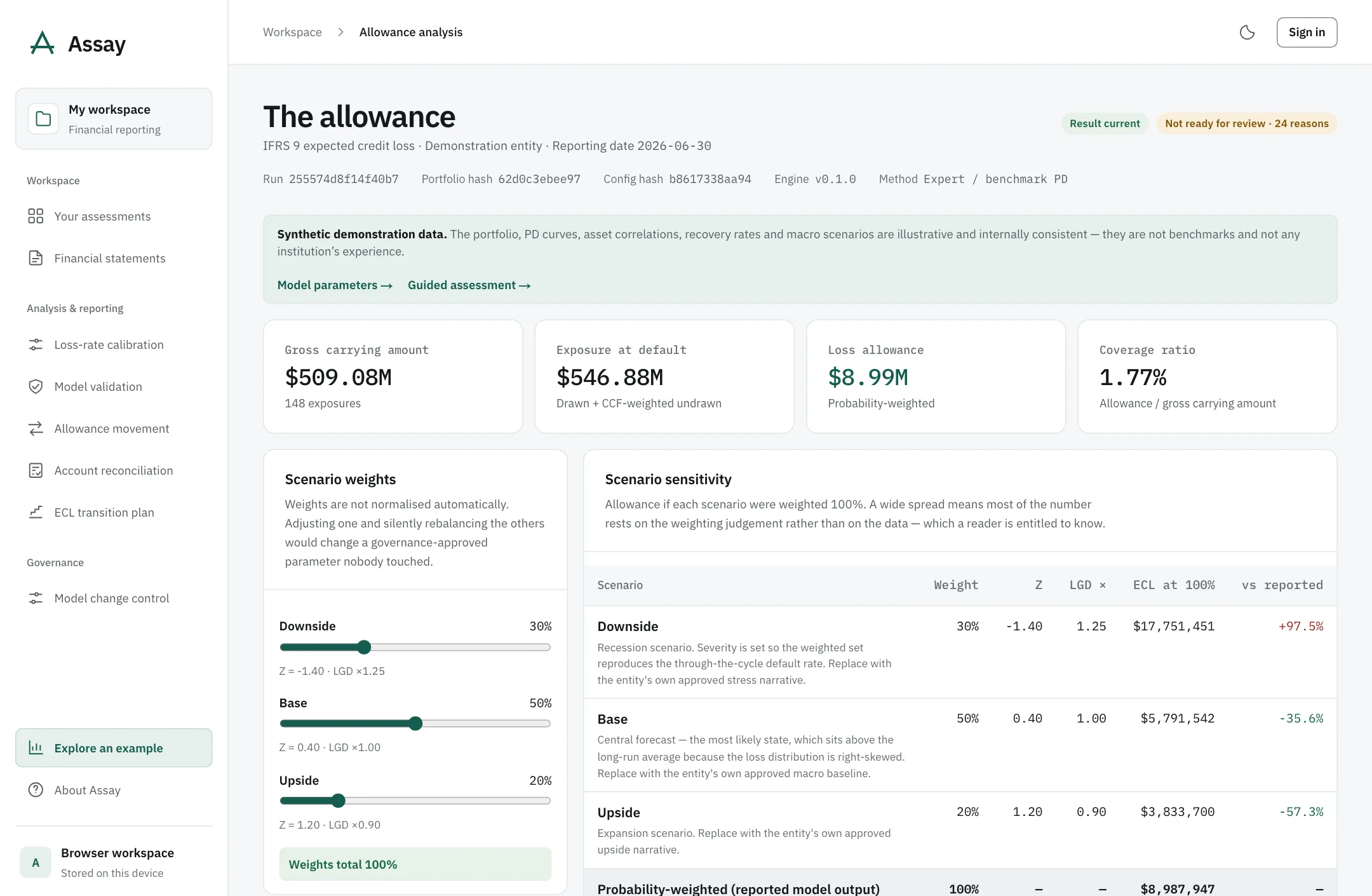
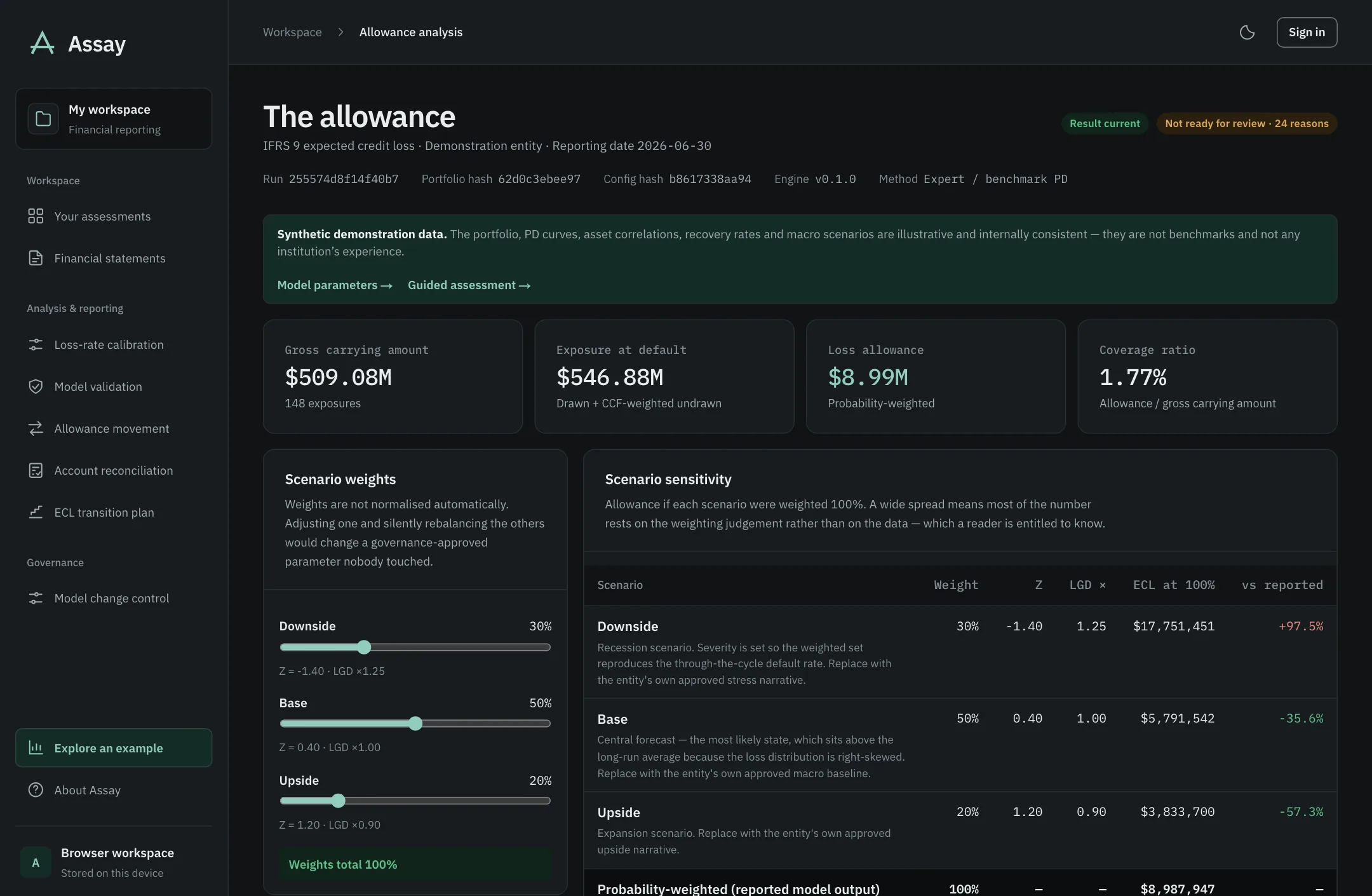
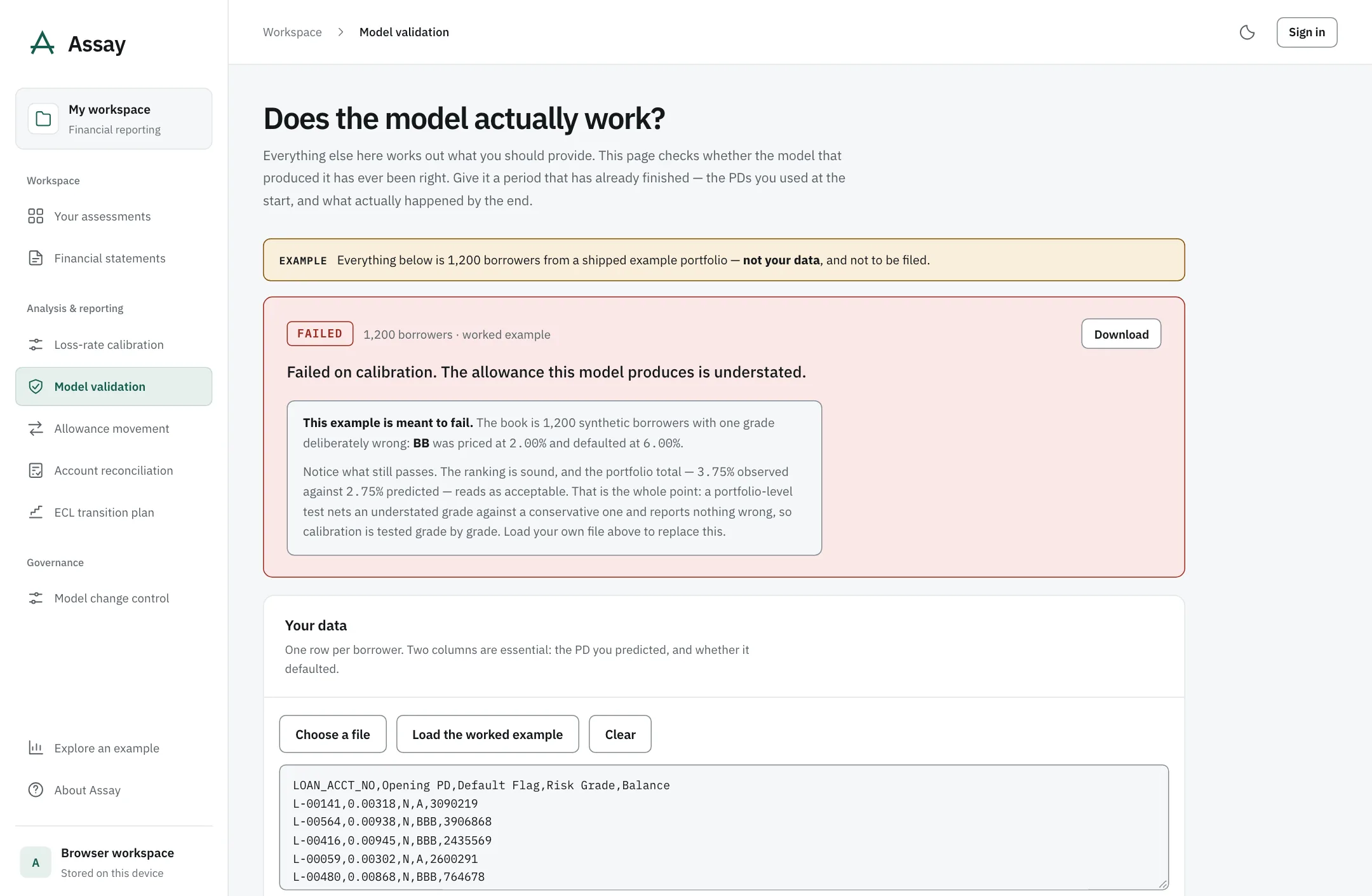
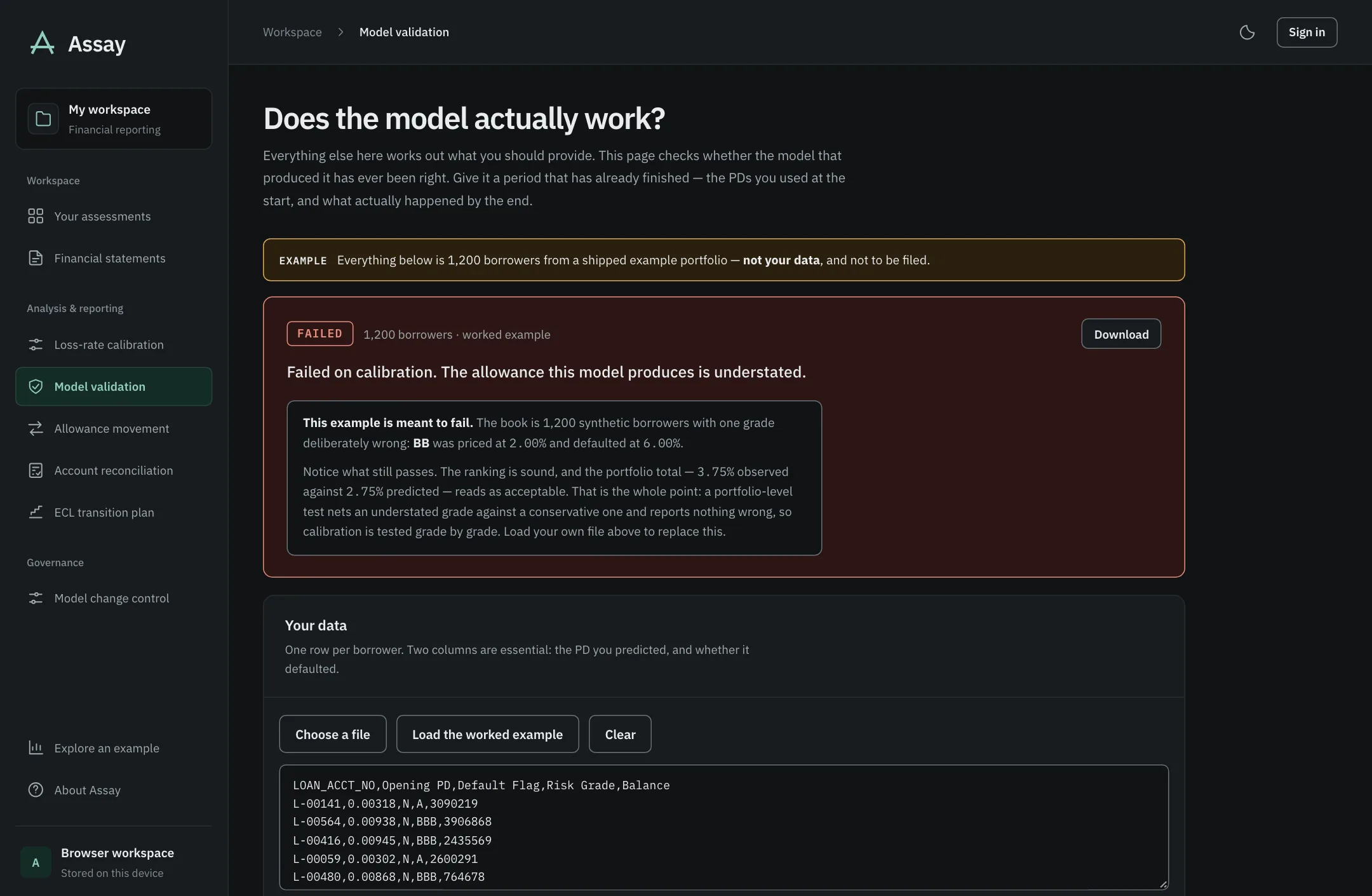
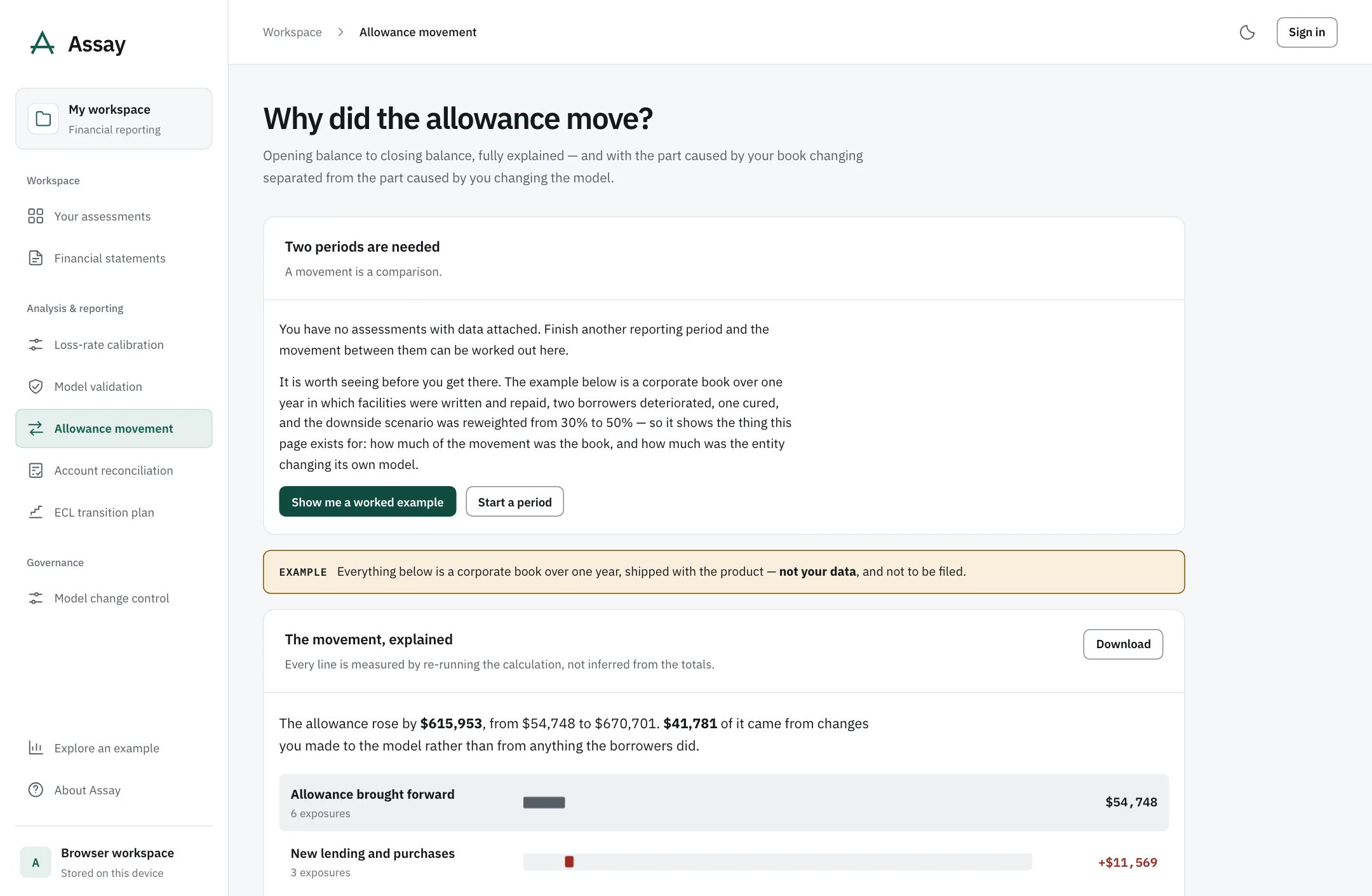
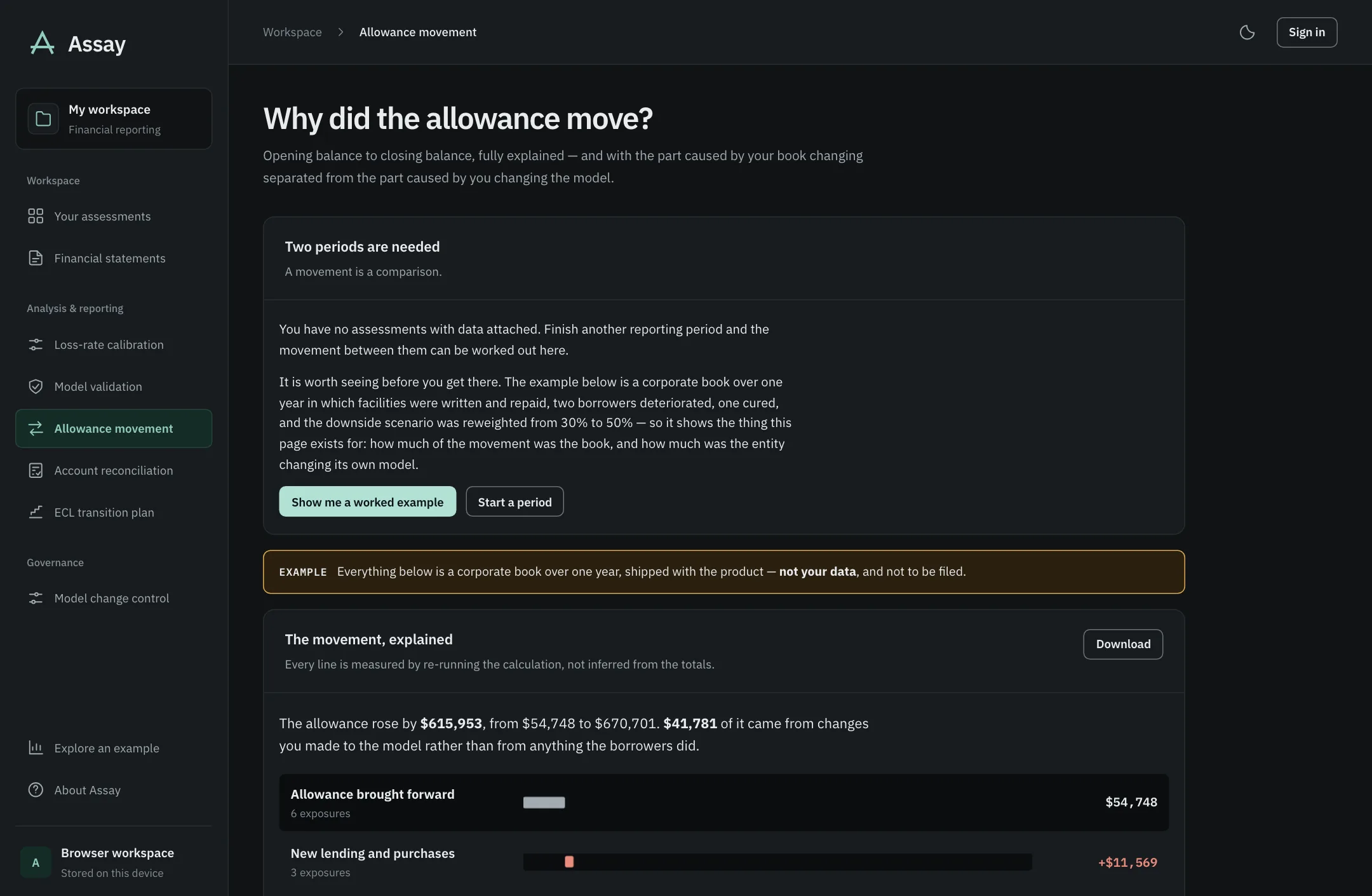
Captured from Bilnax on 2026-09-07. Open any preview to explore the tool yourself.
An engine checked only against its own author’s expectations proves nothing, however many tests it has. These are complete calculations published by other people, reproduced on every change.
| Source | What it works | Published | Bilnax |
|---|---|---|---|
IFRS 9, Illustrative Example 12 | Provision matrix, CU30m of trade receivables | CU 580,000 | CU 580,000 |
IFRS Foundation, ITG July 2016 The slide rounds. Its own working — 30%×22 + 55%×52 + 15%×136 — is 55.6. | One asset, three scenarios, two-step staging | CU 56 | CU 55.60 |
BDO, related company loans, §5.5 | 12-month ECL, 5% × 60% × CU100 | CU 3.00 | CU 3.00 |
Copa Holdings, Form 20-F FY2025 | Filed provision matrix, five ageing bands | US$ 1,950k | US$ 1,950k |
ASE Technology, Form 20-F FY2023 | Filed matrix, plus its individually-impaired column | NT$ 164,408k | NT$ 164,408k |
Bajaj Finance, consolidated accounts FY2025 | Filed stage 1/2/3 gross, allowance and net carrying amount | ₹ 6,982.36 cr | ₹ 6,982.36 cr |
HSBC Bank plc, Annual Report 2024 | Filed stage 1/2/3 and POCI across all IFRS 9 in-scope instruments | £ 925m | £ 925m |
Bajaj Finance, consolidated balance sheet FY2025 | Thirty-one filed balances through the statements engine | ₹ 466,126.83 cr | ₹ 466,126.83 cr |
The second row does not match, and is shown not matching. Where a published figure has been rounded, Bilnax reports the unrounded one.
Produce the number. Keep the proof.
Start an assessmentFree to use, and nothing to install. Your file is read in this browser and never uploaded. An account is needed only to put a model change under review.